Description
| คุณสมบัติ | Value |
| Coil Voltage | 110 V ac/dc |
| Number of Poles | 3 |
| Contact Current Rating | 32 A |
| Power Rating | 15 kW |
| Normal State Configuration | 3NO |
| Contact Voltage Rating | 690 V ac |
| Range | TeSys D Green |
| Series | LC2D |
| Number Of Auxiliary Contacts | 2 |
| Function | Reversing |
| Terminal Type | Screw |
| Width | 92mm |
| Depth | 85mm |
| Maximum Operating Temperature | +60°C |
| Length | 90mm |
| Minimum Operating Temperature | -25°C |
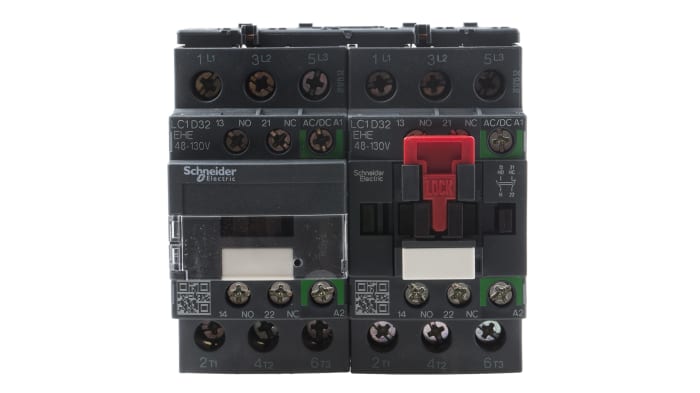
Schneider Electric LC2D TeSys D Reversing Contactors.
TeSys D reversing Contactors from Schneider Electric combine long mechanical and electrical life to offer a high reliable contactor. The LC2D series is preassembled with reversing power busbar and has been designed for motor control or resistive load applications. The TeSys D contactors offer quick simple setup while maintaining compliance with international standards.
Features and Benefits.
- Built-in auxiliary contacts for added switching capability
- Pre-installed interlock
- Screw connections: IP20 finger-safe terminals with both North American and International terminal markings
- Can be panel mounted with screws or DIN Rail mounted
- Easily installed accessories
- Flexible control circuit to suit a wide range of applications
What does the utilisation category AC1 and AC3 mean for the TeSys contactors?
- Contactor utilisation categories define the current making and breaking values, based on the type of load to be controlled and the operating cycle conditions.
- AC-1: This applies to all AC devices with a power factor of at least 0.95. Example of use: resistive load, heating, distribution.
- AC-3: This applies to squirrel cage motors where breaking occurs while the motor is running.
- Example of use: all squirrel cage motors, lifts, escalators, conveyors, bucket elevators, compressors, pumps, mixers, air conditioning units.
What is a reversing contactor?
A reversing contactor is an assembly of two of standard contactors, with a mechanical and electrical interlock connecting them. The interlocks allow only one contactor to be closed (giving power supply to the motor) at any time.
Is the TeSys D range a double break pole type contactor?
Yes, the Tesys D range uses linear translation movement that provides double breaking of the poles.