Description
| คุณสมบัติ | Value |
| AC or DC Input Voltage | ac |
| AC or DC Output Voltage | dc |
| Input Voltage | 120 → 230V ac |
| Output Voltage | 24V dc |
| Output Current | 10A |
| Power Rating | 240W |
| Number of Outputs | 1 |
| Electrical Phase | 1 |
| Type | Switch Mode |
| Height | 125mm |
| Series | SITOP PSU8200 |
| Standards Met | ABS, ANSI/ISA-12.12.01, ATEX, CB, cCSAus, CE Certified, CSA, CSA C22.2, cUL Listed, cULus Listed, E197259, EN 50178, EN 55022 Class B, EN 60529, EN 60715, EN 60950-1, EN 61000-3-2, EN 61000-6-2, GL, IECEx, UL 489, UL 508, UL Listed |
| Output Voltage Adjustment Range | 24 → 28.8V |
| Hazardous Area Certification | ATEX, IECEx |
| Depth | 125mm |
| Width | 55mm |
| Mounting Type | DIN Rail Mount |
| Minimum Temperature | -25°C |
| Ripple And Noise | 50mV Pk-Pk |
| Efficiency | 94% |
| Maximum Temperature | +70°C |
| MTBF | 1292102h |
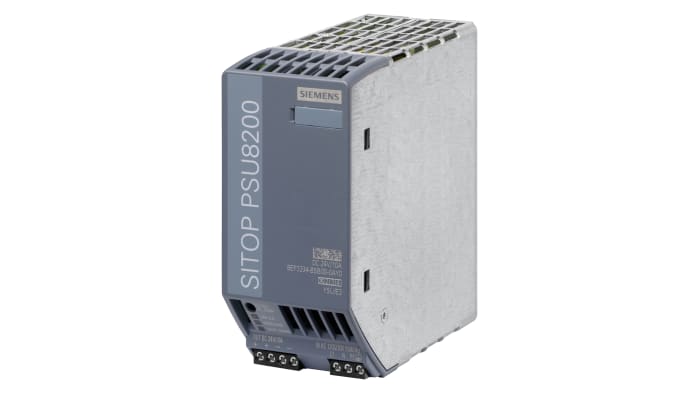
Siemens Switch Mode DIN Rail Power Supply, 120 to 230V AC Input – SITOP PSU8200 Series – 6EP3334-8SB00-0AY0
Looking for an efficient power supply that’ll help prevent expensive downtime in industrial processes? This SITOP power supply from Siemens will bridge power failures for several hours using 24V buffering with battery storage. You can operate it from the battery in standalone mode for purposes such as starting generators. It’s easy to configure thanks to the automatic detection of battery modules, and the totally integrated automation (TIA) saves time during the planning stage and in operation. Power supplies of this type are commonly found in relays, sensors and motors.
• Wide operating temperature range of -25°C to +70°C to withstand challenging conditions
• Overcurrent protection guards against damage
• MTBF (mean time between failures) of 1,292,102 hours for a reliably long service life
• Space-saving slim design with dimensions of 125 (H) x 125 (D) x 55mm (W)
What is meant by ‘totally integrated automation’?
Totally integrated automation (TIA) enables data to be generated from a common base, enhanced and then fed back into the automation process. This ensures production can be maintained continuously at the optimal level.